
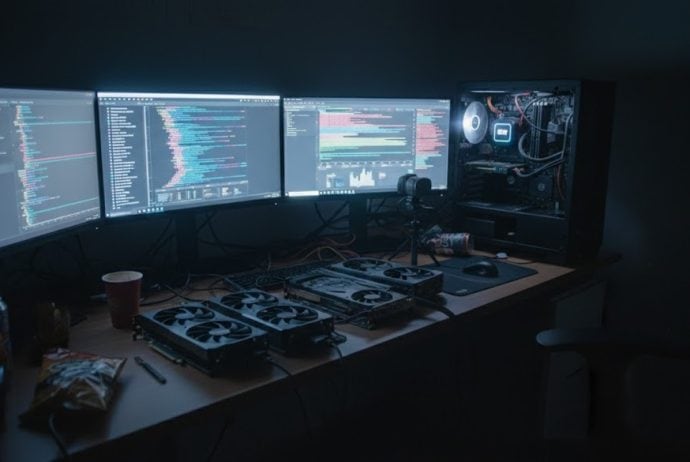
In an era of digital media consumption where video content dominates internet traffic, the ability to process and deliver video quickly and efficiently has become a cornerstone of modern online platforms. Whether it’s streaming services like Netflix, user‑generated video platforms, or adult content delivery networks such as YouPorn, high‑performance video encoding is critical to providing smooth, real‑time playback without lag or buffering. At the heart of this challenge lies a powerful technology: the Graphics Processing Unit (GPU).
GPUs were originally designed to accelerate graphics rendering for video games and 3D applications. However, their highly parallel architecture makes them uniquely suited for accelerating a wide range of computational tasks — including video encoding. In this article, we’ll explore the role GPUs play in real‑time video encoding, why they matter for high‑performance media servers, and how they have transformed the video delivery landscape.
Understanding Video Encoding
What Is Video Encoding?
Video encoding is the process of converting raw video data into a compressed digital format suitable for storage and transmission. This involves applying compression algorithms — such as H.264, HEVC (H.265), AV1, and VP9 — to reduce file size while preserving the quality of the visual content.
Every video you stream on your phone or TV has gone through this workflow:
- Capture: A video is recorded (e.g., by a camera or generated by software).
- Encoding: The raw frames are compressed into a standardized video format.
- Distribution: The encoded file is delivered to end users via the internet.
- Decoding: The user’s device decompresses and displays the video.
The faster and more efficiently a platform can encode video, the better experience it can offer its users.
Why Real‑Time Encoding Matters
Real‑time encoding refers to the ability to process and compress video as it’s being captured or streamed. This is essential for:
- Live streaming applications
- Video conferencing
- On‑demand video upload services
- Broadcasting
Without real‑time encoding, video delivery would be plagued by delays, buffering, and lowered visual quality — especially under heavy loads.
CPU vs. GPU: The Encoding Battle
Traditional CPU Encoding
For many years, encoding was handled exclusively by Central Processing Units (CPUs). CPUs excel at a wide variety of tasks, offering versatility and strong single‑thread performance. However, video encoding is inherently parallel — meaning many operations can be performed simultaneously — a feature that does not play to the strengths of a CPU’s architecture.
A typical CPU might have between 4 and 64 cores, limiting how much parallel work it can perform. Real‑time encoding of multiple video streams can easily overwhelm a CPU‑only system, leading to latency and increased processing time.
Enter GPUs
In contrast, GPUs possess hundreds or thousands of smaller, efficient cores designed for multi‑threaded tasks. A single GPU can handle thousands of simultaneous operations, making it ideal for video encoding workloads where parallel processing is key.
GPUs excel in situations where similar computations need to be performed repeatedly — precisely the nature of video compression algorithms.
How GPUs Accelerate Video Encoding
Parallel Processing Architecture
The core advantage of GPUs is their architecture:
- Massive parallelism: GPUs can execute many operations simultaneously.
- High throughput: Designed to handle vast amounts of data in parallel.
- Dedicated video processing units: Modern GPUs include specialized hardware for video encoding and decoding — such as NVIDIA’s NVENC and AMD’s VCE/VCN.
These qualities allow GPUs to:
- Encode multiple video streams at once.
- Significantly reduce encoding latency.
- Lower the CPU workload, freeing it for other tasks.
GPU‑Accelerated Encoding APIs and Frameworks
There are several key APIs and frameworks that facilitate GPU acceleration in video encoding:
- NVIDIA NVENC: A dedicated hardware encoder built into NVIDIA GPUs.
- Intel Quick Sync Video: A hardware‑based encoder on Intel CPUs with integrated graphics.
- AMD AMF / VCN: Hardware accelerated video encode/decode on AMD GPUs.
- FFmpeg with GPU support: A widely used open‑source multimedia framework that can leverage GPU acceleration for encoding.
These tools allow developers to offload heavy encoding tasks to the GPU while managing workflows seamlessly.
Why GPUs Matter for High‑Performance Media Servers
The Demand for High Throughput
High‑performance media servers often handle hundreds or thousands of concurrent video streams. Consider the workloads for:
- Netflix: Serving millions of viewers worldwide with adaptive bitrate streaming.
- Live sports or events: Real‑time encoding for viewers across different devices.
- Adult content platforms like YouPorn: Handling a massive volume of user uploads and streaming requests.
These platforms must encode video quickly and efficiently. GPUs give them the ability to scale without exponentially increasing hardware costs.
Adaptive Bitrate Streaming
Modern streaming services use adaptive bitrate streaming (ABR) to deliver the best possible video quality based on a user’s network conditions. This requires creating multiple encoded versions of the same video at different resolutions and bitrates — a process that can overwhelm CPUs if done at scale.
GPUs accelerate the creation of these multiple renditions, reducing processing time and enabling faster delivery to users.
Lower Total Cost of Ownership (TCO)
While GPUs are more expensive per unit than CPUs, they offer:
- Higher throughput
- Lower energy consumption per encoded stream
- Reduced need for scaling out server farms
This often results in lower overall infrastructure and operational costs for companies that rely heavily on real‑time encoding.
Real‑World Use Cases of GPU Encoding
Streaming Services (e.g., Netflix)
Netflix employs GPU acceleration to encode its vast library of movies and TV shows in multiple formats. With a global audience accessing content on a variety of devices — from smartphones to 4K TVs — efficient encoding is essential. GPUs make it possible to:
- Encode video in multiple formats and bitrates
- Re‑encode content as standards evolve (e.g., AV1 adoption)
- Deliver content with minimal latency
User‑Generated Content Platforms (e.g., YouPorn)
Adult content sites, like other video platforms, face unique scaling challenges:
- Constant stream of user uploads
- Need for rapid processing to make content available
- High concurrency in viewership
GPU acceleration allows these platforms to encode video quickly, reducing time‑to‑view for new uploads and ensuring smooth playback for users across different devices.
Live Streaming & Broadcasting
Live events such as:
- Gaming streams
- Sports
- Webinars
all demand real‑time encoding with minimal delay. GPUs enable broadcasters to maintain high quality while accommodating large audiences simultaneously.
Technical Benefits of GPU‑Accelerated Encoding
1. Faster Encoding Times
GPUs dramatically accelerate the encoding process by distributing workloads across many cores. This results in:
- Quicker transcoding of videos
- Faster processing of live streams
For services dealing with massive video volumes, this speed is a competitive advantage.
2. Scalability
GPUs offer scalability that CPUs alone can’t match:
- Handle more simultaneous streams
- Support higher resolutions (e.g., 4K, 8K)
- Enable complex encoding algorithms like HEVC and AV1 efficiently
3. Quality at Lower Bitrates
Advanced GPU encoders can maintain video quality even at lower bitrates — which:
- Reduces bandwidth costs
- Improves playback on limited or fluctuating connections
This is especially valuable for mobile viewers and users in regions with slower internet.
4. Offloading CPU Workload
By shifting encoding tasks to the GPU:
- The CPU is freed to handle other server tasks.
- Overall system efficiency improves.
- Latency is reduced.
Challenges and Considerations
Cost and Infrastructure Complexity
GPUs are more expensive than CPUs, and deploying GPU‑accelerated encoding at scale requires careful planning:
- Selecting compatible hardware
- Configuring servers to balance CPU and GPU workloads
- Monitoring GPU utilization to avoid bottlenecks
However, the long‑term performance gains often justify the upfront investment.
Compatibility and Standards
Different GPUs may support different codecs and feature sets. Engineers must ensure compatibility with:
- Industry standards (e.g., H.264, HEVC, AV1)
- End‑user devices
- Content protection and DRM systems
This adds complexity to system design and testing.
Software Support and Maintenance
Using GPU‑accelerated frameworks requires:
- Up‑to‑date drivers
- Software libraries with GPU support
- Routine maintenance to handle updates and security patches
It’s essential to align software and hardware roadmaps to avoid compatibility issues.
Future Trends in GPU Video Encoding
Emergence of AV1 and Next‑Gen Codecs
New video codecs like AV1 offer superior compression over traditional formats. But they are more computationally intensive.
GPUs play a pivotal role in making next‑gen codecs viable, enabling real‑time encoding that would be impractical on CPUs alone.
Cloud‑Based GPU Encoding
Cloud platforms now offer GPU instances tailored for media processing. These services allow companies to:
- Scale on demand
- Avoid large upfront hardware investments
- Pay only for the resources they use
Cloud GPU encoding is becoming a popular choice for startups and established media companies alike.
AI‑Enhanced Encoding
Artificial Intelligence (AI) and machine learning are beginning to influence video encoding. GPUs, already used for AI workloads, can:
- Predict optimal encoding strategies
- Improve compression efficiency
- Enhance visual quality through upscaling and noise reduction
This convergence of AI and GPU acceleration promises to further transform real‑time video workflows.
Best Practices for Implementing GPU Encoding
1. Benchmark and Monitor Performance
Measure performance regularly to ensure:
- Encoding tasks are efficiently distributed
- GPUs are properly utilized
- Bottlenecks are identified early
Tools like NVIDIA’s nvidia‑smi and monitoring dashboards help maintain performance at scale.
2. Optimize Workloads According to Use Case
Different platforms have different needs:
- On‑demand streaming may focus on multi‑bitrate encoding.
- Live streaming prioritizes latency.
- Social platforms emphasize rapid turnaround.
Configure encoding pipelines based on workload priorities.
3. Stay Current with Software and Drivers
Encoding frameworks and GPU drivers evolve rapidly. Ensuring your stack is up to date maximizes performance and security.
4. Plan for Redundancy and Failover
High‑availability media services require:
- Redundant GPU servers
- Failover systems
- Load balancing
These measures ensure uninterrupted service even under peak demand.
Conclusion
GPUs have revolutionized the way video content is processed and delivered in real time. From streaming giants like Netflix to fast‑moving platforms handling user‑generated content — including YouPorn — GPU‑accelerated encoding enables high throughput, low latency, and efficient scalability.
By leveraging the parallel processing power of GPUs, media servers can encode more streams, support advanced codecs, and deliver better quality video to users worldwide. As the demand for online video continues to grow and new standards like AV1 emerge, the role of GPUs in real‑time video encoding will only become more critical.
For any organization serious about performance and scalability in video delivery, investing in GPU‑accelerated encoding is no longer optional — it’s essential.